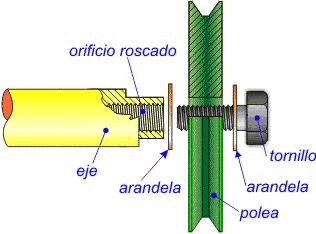
is used in the conversion of a movement rotating in a linear continuous when necessary clamping force or a large reduction ratio. This utility is especially appreciated in two practical applications: Union
removable objects. To what uses threads with grooves in "V" because its friction prevents loosening easily. It found in almost all types of objects, or using as nut unite the material itself (in this case used as a threaded nut on the object itself) or pinning the objects between the head of screw and nut. Using
as nut material itself is used in fastening systems of pulleys, computers, locks, motors, appliances ...
Holding the object between the screw and nut is used in: steel structures, assembly of thin sheets, as the rotation axis articulated objects (hospital bed, compass, sunglasses ...), etc.
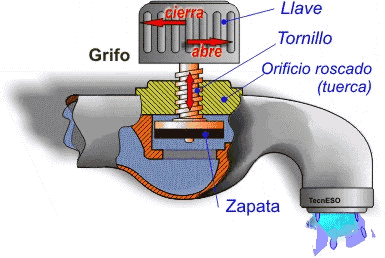
displacement mechanism. For the commonly used square threads (one or more wires) due to its low friction. It is found in many everyday objects: taps, bottle caps and bottles, lipsticks, glue sticks, lifting of workshops, car jacks, clamps, clips, machine tools, corkscrews ...
For example, in the case of taps allows us to open (or close) the passage of water raising (or lowering) the shoe as we turn the key properly.
When the linear progress requires great precision (eg, measuring instruments) this device replaced with great advantage to the system rack-pinion .
Description
for the proper functioning of this mechanism need at least a screw which mates perfectly a nut (or a threaded hole).
This technical system can be raised in two basic ways:
A screw fixed position (can not move longitudinally) that the spin causes the displacement of the nut. The bar
gluing the screw does not move, but its rotation causes the cylinder Queue up or down because this is what makes the nut.
a nut or threaded hole fixed (can not rotate or move longitudinally) that produces the displacement of the screw when it rotates (the water before it can be considered an example of this operation.)
Features screw-nut system has a big advantage over other systems for converting rotary motion into longitudinal: each turn of the screw nut only moves the separation distance is between fillets ( pitch ) so that the clamping force (longitudinal) is very large.
On the other hand, has the disadvantage that the system is not reversible (we can not apply a longitudinal movement and get a dial).
screw-nut system and sliding mechanism is used in many machines can offer service in both systems that require high precision of movement (balance, micrometer screws, position transducers, position ...) and low-precision systems .
Although most of the screw-nut systems are manufactured in steel, also can be found made of other metals (bronze, brass, copper, nickel, stainless steel and aluminum) and plastics (nylon, Teflon, polyethylene, pvc ...), all depends on your operating conditions.
removable objects. To what uses threads with grooves in "V" because its friction prevents loosening easily. It found in almost all types of objects, or using as nut unite the material itself (in this case used as a threaded nut on the object itself) or pinning the objects between the head of screw and nut. Using
as nut material itself is used in fastening systems of pulleys, computers, locks, motors, appliances ...
Holding the object between the screw and nut is used in: steel structures, assembly of thin sheets, as the rotation axis articulated objects (hospital bed, compass, sunglasses ...), etc.
displacement mechanism. For the commonly used square threads (one or more wires) due to its low friction. It is found in many everyday objects: taps, bottle caps and bottles, lipsticks, glue sticks, lifting of workshops, car jacks, clamps, clips, machine tools, corkscrews ...
For example, in the case of taps allows us to open (or close) the passage of water raising (or lowering) the shoe as we turn the key properly.
When the linear progress requires great precision (eg, measuring instruments) this device replaced with great advantage to the system rack-pinion .
Description
for the proper functioning of this mechanism need at least a screw which mates perfectly a nut (or a threaded hole).
This technical system can be raised in two basic ways:
A screw fixed position (can not move longitudinally) that the spin causes the displacement of the nut. The bar
gluing the screw does not move, but its rotation causes the cylinder Queue up or down because this is what makes the nut.
a nut or threaded hole fixed (can not rotate or move longitudinally) that produces the displacement of the screw when it rotates (the water before it can be considered an example of this operation.)
Features screw-nut system has a big advantage over other systems for converting rotary motion into longitudinal: each turn of the screw nut only moves the separation distance is between fillets ( pitch ) so that the clamping force (longitudinal) is very large.
On the other hand, has the disadvantage that the system is not reversible (we can not apply a longitudinal movement and get a dial).
screw-nut system and sliding mechanism is used in many machines can offer service in both systems that require high precision of movement (balance, micrometer screws, position transducers, position ...) and low-precision systems .
Although most of the screw-nut systems are manufactured in steel, also can be found made of other metals (bronze, brass, copper, nickel, stainless steel and aluminum) and plastics (nylon, Teflon, polyethylene, pvc ...), all depends on your operating conditions.


0 comments:
Post a Comment